SMOKE IN THIS LIFE, NOT THE NEXT
Tue, Sep 8 — Nativity of the Blessed Virgin Mary
The dawn of her life becomes the dawn of ours.
Cigar: Mild Connecticut
Drink: Bulleit
Reflection: What name do I call upon in fear?
The Nativity of Mary arrives like a sunrise — quiet, steady, unhurried. Her birth is the first soft light of the Incarnation, the beginning of God’s long‑prepared mercy. Before the Cross, before the empty tomb, before Pentecost, there is simply a girl born into the world, carrying in her very being the future of every soul who will ever cry out for help.
Tuesday draws us to the Holy Face, the gaze that sees through a man and steadies him. Fear always tries to rename us, whispering identities that do not belong to sons. But the Holy Face speaks truth. When fear rises, the name we call upon reveals our allegiance. Mary’s birth reminds us that God has already given us a Mother whose presence steadies the trembling soul, and a Son whose Face burns away the falsehoods we carry.
This day also turns our hearts toward the holy souls — those who long for that Face with a burning love. Scripture tells us, “Thus he made atonement for the dead that they might be absolved from their sin.” The Church has always prayed for her dead: at funerals, cemeteries, novenas, and Masses. St. Augustine teaches that our suffrages aid only those whose purification is underway, whose hope is certain but not yet complete.
Let us crowd heaven with more and more intercessors. Let the smoke rise tonight as a quiet offering. Let the Holy Face shine upon the living and the dead.
SEPTEMBER 8 Tuesday-Feast of the Nativity
of Mary
Pardon Day
1 Maccabees, Chapter 16, Verse 6
The
narrative is nearing its end. Simon, the last of the Maccabean brothers to rule
over the Jewish people, is getting too old to lead the troops into battle. He
passes on the military leadership to his sons Judas and John, who, like real
leaders, lead from the front. He is the first to step into danger.[1]
Even in our present day we
can see similarities in our own heroes and villains.
What should we take
away from this book?
The
contest described in this book is a struggle, not simply between Jew and
Gentile, but between those who would uphold the law and those, Jews or
Gentiles, who would destroy it. The books severest condemnation goes, not to
the Seleucid politicians, but to the lawless apostates from among the Jewish
people, adversaries of Judas and his brothers, who are models of faith and
loyalty.
Fear binds us[2]
There is so much fear and
agony in us. Fear of people, fear of God, and much raw, undefined,
free-floating anxiety. I wonder if fear is not our main obstacle to
prayer.
When we enter the presence
of God and start to sense that huge reservoir of fear in us, we want to run
away into the many distractions that our busy world offers abundantly.
But we should not be
afraid of our fears. We can confront them, give words to them, cry out to God,
and lead our fears into the presence of the One who says: “Don’t be afraid, it
is I.”
(Henri Nouwen, Spiritual Direction,
58)
Hope is to each of us what sunshine
is to a garden.
Copilot’s Take
The closing chapters of
Maccabees reveal a truth that echoes across every age: the gravest danger to a
people is not always the enemy beyond its borders, but the collapse of courage
within its own ranks. John Maccabeus crossing the wadi first is more than a
tactical decision; it is a moral act. He refuses to let fear govern the
conscience of his people. The Catechism teaches that societies falter when
individuals surrender to fear, apathy, or silence, allowing sin to become
embedded in culture as “structures of sin” (CCC 1869). The wadi becomes
the threshold every generation must cross.
Fear is not merely an emotion; it is a spiritual pressure that tempts the human heart away from fortitude. CCC 1808 defines fortitude as the virtue that “ensures firmness in difficulties” and “constancy in the pursuit of the good.”
When fear governs a community, moral clarity erodes. People hesitate to name evil as evil. They retreat into distraction, outrage, or despair. This is why the Maccabean narrative condemns internal apostasy more severely than foreign oppression: the collapse of conscience within a people is more destructive than any external threat.
This dynamic is visible in
contemporary America. When a society cannot reach moral consensus on an act
that is objectively evil, it reveals a fracture in its shared conscience. The
recent 11–1 mistrial in the Clancy case is an example of this phenomenon.
Without entering political territory, it is clear that such a division signals
fear, confusion, and the weakening of moral categories. CCC 2284–2287 warns
that scandal arises when public processes fail to uphold justice or when moral
responsibility is compromised by pressure or ideology. A mistrial in the face
of grave wrongdoing is not merely a legal event; it is a cultural symptom.
The moral stakes deepen when
the lone juror who held firm is publicly singled out by the defense attorney.
This is not simply courtroom rhetoric; it is a cultural act of intimidation.
CCC 1782 teaches that no one may be forced to act against conscience, and CCC
2286 warns against actions that “manipulate or pressure” others into violating
it. Publicly isolating a juror who resisted the majority sends a message that
moral courage may come at personal cost. This is precisely the dynamic seen in
Maccabees: those who uphold the law are pressured, shamed, or threatened by
those who have abandoned it.
Such behavior contributes to
the rise of “structures of sin” (CCC 1869), where cultural forces subtly
punish moral courage and reward conformity. It is not the external enemy that
erodes justice, but the internal willingness to intimidate or shame those who
uphold it. The wadi becomes harder to cross when those who step forward are
publicly targeted. A society that discourages conscience cannot defend itself
against evil; it becomes divided, hesitant, and morally confused.
The Catechism insists that
confronting evil begins with the renewal of conscience, not with the escalation
of conflict. CCC 2242 teaches that when cultural pressures distort moral
judgment, conscience must stand firm. The first act of resistance is interior:
refusing to cooperate with dishonesty, cruelty, or the dehumanization of
others. The second act is public: bearing witness to truth with clarity and
charity. A nation is defended first by the integrity of its people, not the
ferocity of its leaders.
Hope is the virtue that
prevents surrender. CCC 1817 teaches that hope “keeps man from discouragement”
and sustains him when the world appears dark. Hope is not optimism; it is the
theological strength that enables a person to step forward when others hesitate.
It is the interior light that allows a community to confront evil without
becoming hardened, cynical, or vengeful. Hope is to the soul what sunshine is
to a garden: it coaxes life where fear has scorched the ground. And like John
Maccabeus, those who seek the good must be willing to step forward first,
trusting that fidelity to God’s law is the true defense of any nation.
The Feast of the Nativity of the Blessed Virgin Mary[3]
THIS feast is a
commemoration of that happy and joyful day on which the ever-blessed virgin
Mother of God first saw the light of day. The Church accordingly sings on this
day, “Thy nativity, virgin Mother of God, has brought joy to the whole world;
for from thee has come forth the Sun of justice, Christ the Lord, Who putting
away cursing bestowed blessing, and by overcoming death obtained for us life
eternal."
Let us honor Mary,
especially by imitation of those virtues of hers which are to us, as St. John
Damascene says, an open book of instruction; let us rejoice in her prerogatives
and glory; let us encourage others in the veneration of her; let us, in our need,
have recourse to her, who, according to the name Star of the Sea with which the
Church salutes her, shines for all who sail upon the dangerous sea of the
world. For this reason St. Bernard calls out to each one of us, " Take not
your eyes from the light of this star if you would not be overwhelmed by the
waves; if the storms of temptation arise, if you are thrown upon the rocks of
affliction, look to the star, invoke Mary. Are you confounded at the enormity
of your sins, are you ashamed at the defilement of your conscience, are you
terrified on account of the dreadful judgment, so that you begin to be
overpowered by sadness, or even to sink into the abyss of despair, then turn
your thoughts to Mary. In dangers, in distress, in doubt, call on Mary. She will
not be far from your mouth, or your heart; and that you may obtain her
intercession omit not to imitate her conduct. When you follow her, you will not
go astray; when you invoke her, you will no longer be in doubt; when she
supports you, you will not fall; when she leads you, you will surely come to
eternal life, and will find by your own experience that she is justly called
Maria that is, Star of the Sea."
Things to
Do[4]
Learn
prayers to Mary, such as the Angelus, Litany of Loreto, Memorare, Hail Mary,
and Hail Holy Queen. Learn and sing various hymns to Mary, such as the Salve
Regina, Immaculate Mary, Hail Holy Queen.
Start
researching and planning a Mary Garden, or a special plant or flower for each
feast day of Mary.
This can be for next spring, but if some bulbs are to be included, this is the
time to plant them! Decorate the house, family table or family altar with
flowers or special Marian decor.
Contemplate
on how all the feasts of Mary point to the mysteries of Christ and our
salvation history. Biblical readings: Proverbs 8:22-35 and Matthew 1:1-16 (this
points to the appreciation of the heritage and family of Jesus).
Have
a birthday party for Mary, with a specially decorated birthday cake and
birthday decorations. Blue is the traditional color of Mary's mantle, so
incorporating blue into the decor and food is quite appropriate. Try making an all-white
cake symbolizing Mary's purity, or cookies with white icing. White meringue
cookies (or kisses) would also remind one of Mary's sinlessness. Birthday
parties don't need special explanations for children. Have each child present a
"gift" to their Mother Mary, such as spiritual bouquets, faults or
virtues to work on, corporal works of mercy, etc. Learn to make string knot
rosaries to give as "favors."
Eat some form of blueberries on this day, particularly in the morning -- blueberry muffins or blueberry pancakes, blueberry pie or just fresh blueberries on your cereal. The blue is symbolic of Mary's blue mantle.
Find
out about the devotion to "Maria Bambina" or "Baby Mary."
Women for Faith and Family have some wonderful ideas for this
feast day.
The
Catholic Tradition of Harvest Feasts of Thanksgiving
The High Middle Ages
(approximately 1000 to 1250 A.D.) marked the beginning of harvest feasts of
thanksgiving with Catholic nations. These festivals were attached to particular
saint or feast days. Not all days were celebrated everywhere, but they would vary
in different countries throughout the liturgical year. Each date links to the
CatholicCulture.org page on which the sidebar provides further information in
the sections of Activities, Prayers, Recipes, etc. for the feast day:
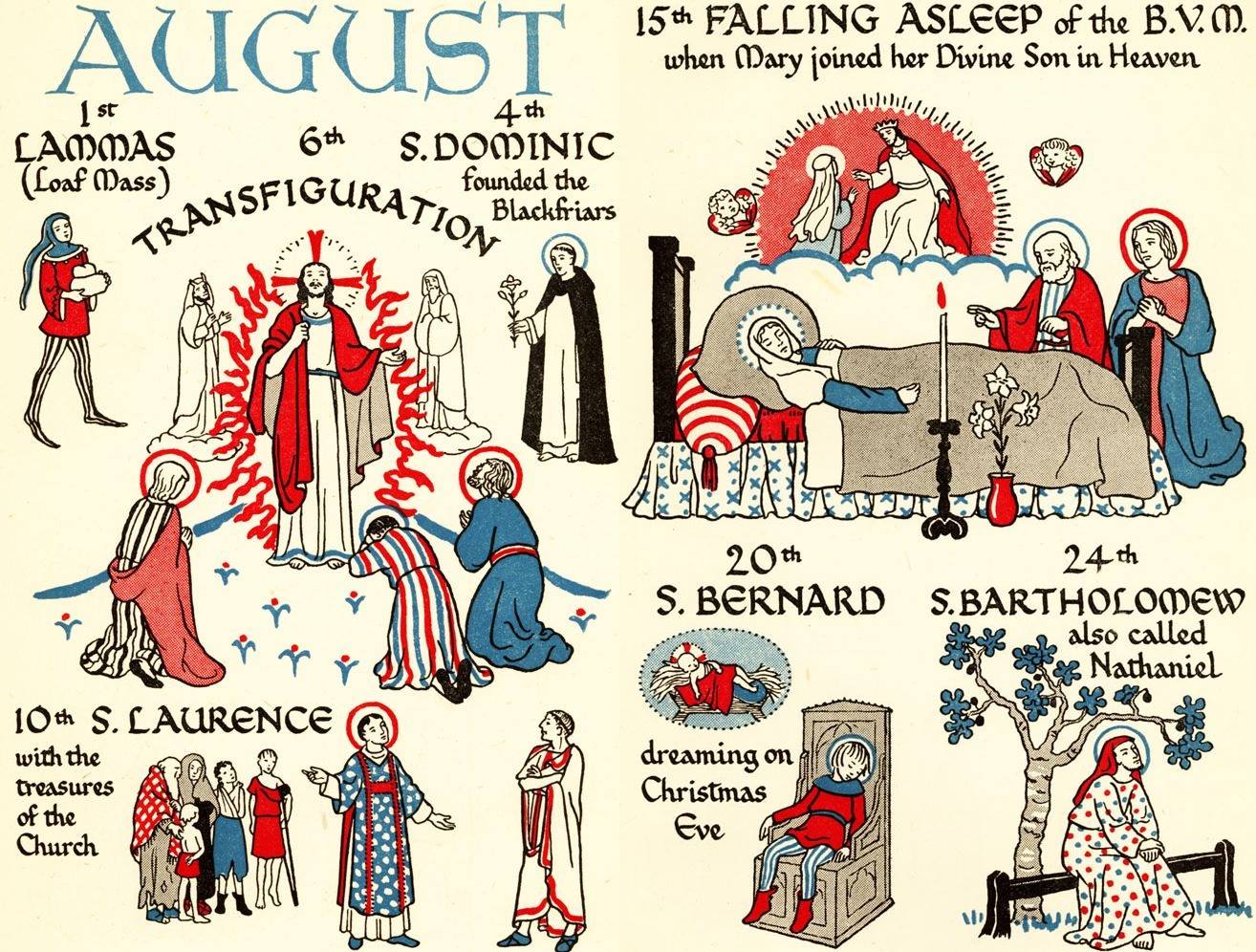
St. Peter in Chains, or Lammas or
Loaf-Mass Day, August 1 in the 1962 Extraordinary Form calendar—Lammas is
Anglo-Saxon origin, celebrating the first fruits of the summer wheat or grain
harvest in the northern English speaking countries of Europe. The Roman Ritual
included a Blessing of the Harvest to use on this feast or the Transfiguration.
Feast of the Transfiguration, August
6—This feast corresponds with the Jewish feast of Booths or Tabernacles. Both
in Eastern churches and in Rome have the blessing of grapes, raisins and other
fruits, wine and also blessing and incorporating the wheat grains in the
celebration, particularly wheat pilaf. For more information, see my two
previous commentaries on the Transfiguration.
Feast of the Assumption, August
15—In many Germanic countries this is thanksgiving harvest for first fruits,
herbs and flowers, with the Roman Ritual including a Blessing of Fruits and
Herbs for this feast. For more information, see my post on the Assumption.
Feast of St. Bartholomew, August
24—Because St. Bartholomew is the patron of shepherds and husbandmen, in
Britain this was another harvest feast for shepherds and farmers. Lamb and
mutton are the traditional foods for this feast.
Feast of the Nativity of Mary,
September 8—For certain regions like Goa, this feast marked the end of the
summer harvest. The Roman Ritual included a blessing of seeds and seedlings for
the fall planting. In France the winegrowers brought grapes to be blessed and
called this feast “Our Lady of the Grape Harvest.” In the Austrian Alps this
was “Drive-Down Day,” bringing herds of cattle and sheep from their summer
pastures. After the work, the thanksgiving festivities would begin.
Feast of St. Michael or Michaelmas, September 29—In England this was a “quarter day” and huge harvest feast, with a roasted goose as the centerpiece.
Solemnity of All Saints, November
1—All Saints’ Day was originally on May 13 in Rome, but the feast day was
transferred to November 1, right at the time of harvest to provide food for the
pilgrims traveling to Rome. I wouldn’t say this was an official harvest feast,
but the timing was around the harvest. I have also included it because of
Father Joseph Minihan’s article: The Church’s Thanksgiving Day.
Feast of St. Martin or Martinmas,
November 11—For most of the European continent Martinmas was the biggest and
final fall harvest feast. The festivities were especially for the wine harvest
and the great winter slaughters of animals. The feasting usually centered
around a Martinmas goose accompanied with apples. Advent used to be 40 days in length,
beginning a few days after St. Martin’s. There were more strenuous requirements
of fasting and abstinence, so Martinmas would also be a celebration to use up
fats and meats in preparation for Advent, similar to Fat Tuesday before Lent.
See my previous post, Feastday Highlights: 11-11, Honoring the Real St. Martin
of Tours.
Feast of St. Leopold, November
15—Most of Austria would wait for their fall harvest feast until St. Leopold’s
day, as he is the patron saint of Austria. Today was also referred to as “Goose
Day” in Austria.
Feast of St. Andrew, November 30—In
Britain also known as “Andermess,” this marks the end of autumn and the last
harvest feast. In later centuries when Advent was shortened, November 30 marked
the beginning of the Advent season. See more information in my previous post,
Anticipating Christmas, Beginning with St. Andrew.
Pardon Day[5]
“The weak can never forgive.
Forgiveness is the attribute of the strong.”– Mahatma Gandhi
Forgiveness, the process
by which an offended party chooses to change the way they feel about someone
who has committed the offense against them. It bears a distinct difference from
the idea of condoning (where one does not see the offense as wrong, and therefore
not needing forgiveness), excusing the action (where you place the blame for
the action on someone else entirely), giving pardon (cleared by a legal
representative), forgetting (where the action no longer exists in memory in any
real or present way), or the act of reconciliation (where the relationship is
restored without the action strictly being forgiven).
On the 8th of
September back in 1974, President Gerald Ford presented a rather controversial
Presidential Proclamation. This proclamation pardoned Richard M. Nixon of all
wrongdoing that was related to that most famous of American scandals, the
Watergate affair. Richard made very clear that he felt he had committed
grievous wrong doings against the people of the United States and the seat they
had granted him. While you are unlikely to be in a position to grant a
presidential pardon, what you can do is be more forgiving on International
Pardon Day. If you are holding a grudge against those who have committed some
offense against you, Pardon Day grants you a valid reason to examine your feelings
and the time that has passed, and to let that resentment and anger go.
“The truth is, unless you let go, unless you forgive yourself, unless you forgive the situation, unless you realize that the situation is over, you cannot move forward.”– Steve Maraboli
What is known about
forgiveness is that it is an act that brings happiness to those who give it,
one can release the hold on the negative emotions they’re harboring in
themselves, but they cannot release the associated guilt for the person who
committed the act. As a result, forgiveness is for the one giving it, rather
than the one who committed the transgression. Research has shown that those who
have chosen to give up resentments live longer lives as a result to an
improvement in their cardiovascular and nervous systems.
Ways to Celebrate
There are a number of good
ways to celebrate International Pardon Day, the simplest being to make sure you
use ‘Excuse Me’ and ‘Pardon Me’ whenever you feel it appropriate. You need to
get by someone, a simple ‘pardon me’ will serve to politely ask them to clear
the way. Did you pass gas, or bump into someone when trying to get past them?
‘Excuse me’ is a good step towards showing you’re truly contrite.
“Forgive your enemies, but never
forget their names.”–
John F. Kennedy
Another,
perhaps more difficult way to celebrate is to take the time to examine the
grudges you carry with you on a day-to-day basis. To think them over and
determine if it’s truly worth carrying that anger and resentment forward. Take
International Pardon Day to set them, and yourself, free from the toxic weight
you’re carrying. You can do it via email, in person, over coffee, or you can
write them a letter. If they’ve passed on, don’t let that stand in your way,
write a letter with everything you’d like to say in it, and then burn it to set
it free.
30 DAY TRIBUTE
TO MARY 25th ROSE: Ascension of Jesus
30
Days of Women and Herbs – Frauendreissiger
MEDICINAL PLANTS Day 23 IMMUNE SYSTEM-Revealed by Heaven to Luz De María
ARTEMISA ANNUA Boosts the immune system. Antimicrobial
activity. Used to fight the malaria parasite. Strengthens psoriasis and
leukemia treatments. Recommended to fight against Ebola, fever, hepatitis B and
C and AIDS. Artemisa plant has the following properties related to the immune
system: Scientific name: Artemisia annua L. Family: Asteraceae Known as: Sweet
Artemisa
The pestilence is renewed by those who serve the antichrist and watch as the economy succumbs. Before this, I invite you, children, to resort to the health of the body by means of what nature provides for the good of the body in the face of the current disease: The use of Artemisia annua L." Blessed Virgin Mary, 10.11.2014 Beloved children of My Immaculate Heart, it is necessary that you strengthen your immune system, the plague is advancing mercilessly. Use the ARTEMISIA plant as an infusion at this time. Blessed Virgin Mary, 04.12.2021
Around the Corner
How
to celebrate Sep 8th
Venture
into the world of science fiction by hosting a Star Trek marathon with friends
or family. Dress up as your favorite character and enjoy a day filled with
intergalactic adventures.
Celebrate
the versatility and beauty of language by challenging yourself to write a story
or poem using as many ampersands as possible on National Ampersand Day. Support literacy efforts by
donating books to a local library or volunteering to read to children on International Literacy Day. Take a moment to appreciate the
art of acting by watching a play or movie starring your favorite actors on
Actors’ Day.
Learn
about iguanas and their conservation by visiting a local zoo or researching
ways to protect these fascinating creatures on National Iguana Awareness Day. Focus on your well-being by
participating in a physical therapy session or practicing some therapeutic
exercises on World Physical Therapy Day.
End
your day on a positive note by practicing forgiveness and reaching out to mend
any broken relationships on Pardon Day.
Reflect on the power of forgiveness and the importance of letting go of grudges
to make room for peace and harmony in your life. Embrace the spirit of each
holiday by spreading kindness, love, and gratitude wherever you go.
Daily
Devotions
Unite
yourself in the work of the Porters of
St. Joseph by joining them in fasting: Today's Fast: Protection
of Traditional Marriage
Religion
in the Home for Preschool: September
Litany of the Most Precious
Blood of Jesus
Offering to
the sacred heart of Jesus
Rosary
WHISTLE STOP (1946)
George Raft • Ava Gardner • Victor McLaglen Directed by Léonide Moguy • United Artists A Small‑Town Noir of Jealousy, Desperation, and the Slow Burn of Bad Decisions Where Desire Turns Sour, Loyalty Frays, and Every Return Home Awakens Old Dangers
Whistle Stop is early‑cycle noir with a rural pulse — a story not of big‑city corruption but of small‑town tension, where old grudges simmer, old loves reignite, and every man carries the weight of choices he hoped the town had forgotten. Set against train whistles, dim bars, and the claustrophobic intimacy of a place too small to hide in, the film reveals how quickly a returning drifter can become the spark that sets old rivalries ablaze. It is a tale of emotional erosion, where danger grows not from organized crime but from wounded pride, jealousy, and the slow tightening of fate around people who cannot escape themselves.
George Raft plays Kenny Veech with stoic restraint — a man who returns home expecting familiarity but finds only suspicion and unfinished business. Ava Gardner, luminous even in shadow, embodies Mary, the woman whose beauty and independence ignite every man’s insecurity. Victor McLaglen brings brute force and wounded loyalty to Gitlo, whose friendship with Kenny becomes the hinge on which betrayal and violence turn.
The film moves with the inevitability of a train pulling into a station — slow, loud, unavoidable. Each choice Kenny makes narrows his path: a rekindled romance, a dangerous alliance, a plan that feels clever until it collapses. The tension is not in elaborate schemes but in the suffocating realization that the past is never past, and that returning home can be the most dangerous journey of all.
This is noir without glamour. The danger is jealousy. The fire is desire. The verdict is the cost of coming back to what should have been left behind.
Film Card — Whistle Stop (1946)
Whistle Stop 1946 • 5.7/10 IMDb • 85 min
A drifter returns to his hometown and finds old loves, old enemies, and old wounds waiting. As jealousy rises and loyalties fray, he becomes entangled in a dangerous scheme that exposes the fragility of trust and the inevitability of consequence. Film Noir • Crime • Small‑Town Drama
Director Léonide Moguy
Writer Philip Yordan
Stars George Raft, Ava Gardner, Victor McLaglen
Studio United Artists
Themes Jealousy, wounded pride, returning home, fatalism
1. Production & Cultural Setting
Post‑War American Unease The film reflects a nation adjusting to peacetime — restless men, uncertain futures, and towns that feel too small for returning veterans.
Ava Gardner’s Rising Stardom Her performance hints at the magnetism that would soon make her a noir icon — beauty as both blessing and curse.
United Artists’ Rural Noir Unlike urban noir, this film uses small‑town settings, train stations, and roadside bars to heighten tension.
The Town as Pressure Cooker Everyone knows everyone; secrets rot in plain sight. The setting becomes a character — intimate, suffocating, unforgiving.
Emotional Noir The danger arises not from gangsters but from human frailty: jealousy, longing, resentment, and the inability to let go.
2. Story Summary
The Return Kenny Veech comes home, expecting familiarity but finding suspicion.
The Spark Mary’s beauty and independence reignite old rivalries.
The Alliance Kenny and Gitlo form a dangerous partnership built on wounded loyalty.
The Scheme A plan emerges — half‑baked, risky, doomed by emotion.
The Collapse Jealousy and betrayal unravel everything; fate arrives like a train that cannot be stopped.
3. Moral & Emotional Resonances
A. Returning Home Can Be a Temptation The past beckons, but not always with mercy.
B. Jealousy Is a Slow Poison It corrodes judgment long before it erupts into violence.
C. Desire Without Discipline Is Destructive Attraction becomes danger when it blinds a man to consequence.
D. Loyalty Misplaced Becomes a Trap Gitlo’s devotion becomes the hinge of betrayal.
E. Fate Is Patient but Unyielding Every choice narrows the path until only consequence remains.
4. Hospitality Pairing — Drawn From the Film’s Spirit
Food — Rural, Simple, Tense Fried chicken — comfort with an edge. Cornbread — the taste of home. Pickled vegetables — sharp, lingering, unsettling.
Drink — Earthy, Heavy, Restless Bourbon — the weight of returning. Rye whiskey — the bite of jealousy.
Atmosphere — The Train Station at Dusk Lighting: Amber, fading. Sound: Distant whistles, murmured conversations. Setting: Wooden benches, dusty floors, shadows stretching long. Symbol: A train timetable — the reminder that departure is always possible, but escape rarely is.
5. Reflection Prompts
Where have I returned to old places expecting peace but finding danger.
Where is jealousy shaping my choices more than truth.
Where am I clinging to a past that cannot be reclaimed.
Where must discipline replace desire in my life.
Where is fate narrowing my path through choices I have not yet confronted.
- Get link
- X
- Other Apps
Comments
Post a Comment